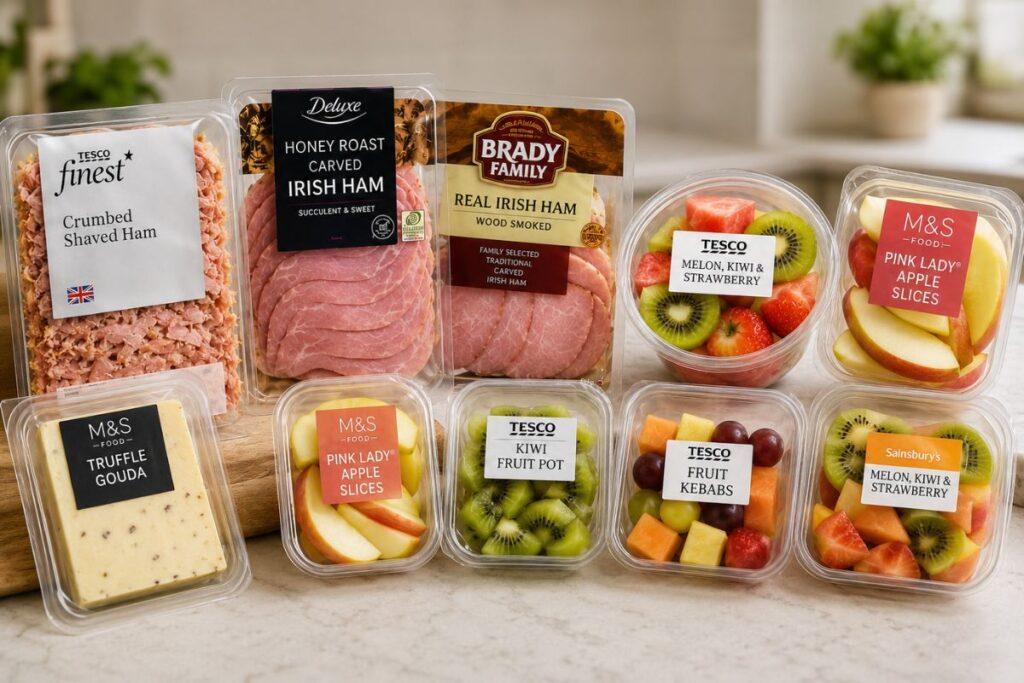
Quick answer: Tesco, Lidl and Marks & Spencer have all issued food safety recalls in the UK this month — three separate recalls in total, not one joint recall. Tesco and Lidl have recalled specific sliced ham batches linked to Listeria monocytogenes. Tesco, along with several other retailers, has separately recalled pre-packaged fruit pots over Salmonella. And M&S has recalled its own Truffle Gouda cheese for Listeria, in a recall that has nothing to do with either of the other two.
The ham recall was issued by supplier O’Brien Fine Foods and mainly affects stock sold in Northern Ireland, with a use-by date of 16 July 2026. The fruit pot recall was issued by supplier PrepWorld and affects products sold at Tesco, Marks & Spencer, Lidl, Asda, Sainsbury’s and Morrisons, with use-by dates of 23 and 24 June 2026. The M&S cheese recall is separate again — a single 150g product, pulled from Northern Ireland stores, with a use-by date of 9 October 2026. Customers who have any of these products are advised by the Food Standards Agency (FSA) not to eat them, and to return them to the store of purchase for a full refund — no receipt required.
Most coverage of this treats it as one blurred story, repeating the same “return it for a refund” line without separating out which product came from which supplier, or which bacteria is actually involved. Instead of repeating that, this article breaks the three recalls apart clearly, covers what most reports have left out, and explains what O’Brien Fine Foods, PrepWorld and M&S have each said about how the contamination happened.
- Three Separate Recalls, Not One: Tesco and Lidl’s ham recall, Tesco’s fruit pot recall, and M&S’s cheese recall are three unrelated events that happen to be running at the same time. They involve different suppliers, different products, and in one case, a different bacterium entirely.
- Listeria vs. Physical Contamination: Listeria is a live bacterium that can replicate slowly in a cold refrigerator. This makes it much more dangerous compared to physical contamination such as glass or plastic.
- O’Brien Fine Foods has said the Listeria contamination in the ham was traced to a single batch of one product. The other four ham items on the list were pulled only because they were made in the same production area on the same day — a precaution, not a confirmed problem.
- Area Specificity: Most of the contaminated ham was supplied through retailers in Northern Ireland. All UK customers are urged to check their refrigerators regardless.
- Ready-to-Eat Fruits Recall: The Salmonella recall on ready-to-eat fruit pots (produced by PrepWorld for Tesco, Marks & Spencer, Asda, Sainsbury’s, and Morrisons) continues.
- M&S Cheese Recall: M&S has pulled its 150g Truffle Gouda (product code 29424887, use-by 9 October 2026) from Northern Ireland stores after Listeria was found in the product — a recall that’s entirely separate from the fruit pot issue.
- No Receipt Necessary: Full refunds are being issued across all three recalls without needing a receipt.
- At-Risk Individuals: High-risk groups, including pregnant women, the elderly, and immunocompromised individuals, are at greater risk from both bacteria involved.
The Full List of Affected Recalled Products
To check your fridge quickly, match the product name, weight, batch code, and use-by date against the official notices below.
1. Sliced Ham Products (Listeria Risk)
| Retailer / Brand | Product Description | Pack Size | Batch Code | Use-By Date |
| Brady Family | Crumb Irish Ham | 80g | 235880 / 235765 | 16 July 2026 |
| Brady Family | Wood Smoked Real Irish Ham | 80g | 235417 | 16 July 2026 |
| Lidl (Deluxe) | Honey Roast Carved Irish Ham | 130g | 235473 | 16 July 2026 |
| Lidl (Deluxe) | Triple Oak Smoked Carved Irish Ham | 130g | 235461 | 16 July 2026 |
| Tesco (Finest) | Crumbed Shaved Ham | 120g | 235412 | 16 July 2026 |
2. Pre-Packaged Fruit Pots (Salmonella Risk)
| Retailer | Product Description | Pack Size | Affected Use-By Dates |
| Tesco | Melon, Kiwi & Strawberry Pots | 250g / 125g | 23 June & 24 June 2026 |
| Tesco | Kiwi Fruit Pot | 100g | 23 June 2026 |
| Tesco | Fruit Kebabs | 290g | 23 June 2026 |
| Marks & Spencer | Café Pink Lady Apple Slices | 90g | 24 June 2026 |
| Marks & Spencer | Pink Lady Apple Slices | 225g | 24 June 2026 |
| Sainsbury’s | Melon, Kiwi & Strawberry / Orange & Kiwi | 220g / 240g | 23 June 2026 |
3. M&S Truffle Gouda (Listeria Risk)
| Retailer / Brand | Product | Pack Size | Product Code | Use-By Date |
| Marks & Spencer | M&S Food Truffle Gouda | 150g | 29424887 | 9 October 2026 |
Five Things Worth Knowing
- This isn’t one recall — it’s three, running at the same time. Tesco and Lidl’s ham, the fruit pots, and M&S’s cheese all trace back to different suppliers and different contamination events. Treating them as a single story is why so much of the coverage online has been vague about which product is actually affected.
- The ham recall isn’t the usual “found some plastic in it” story. It’s Listeria — a bacterium, not a foreign object — and that changes how seriously it needs to be taken.
- Northern Ireland is where most of the affected ham and the M&S cheese were sold. If you shop elsewhere in the UK, you’re less likely to have either, but check the pack anyway rather than assuming.
- Listeria doesn’t need a warm kitchen to grow. It can multiply slowly even inside a cold fridge, which is part of why chilled meats, soft cheese and smoked fish get watched so closely — and why both the ham and the M&S cheese are being treated the same way despite being unrelated recalls.
- Some people are at real risk, others barely notice. Pregnant women, babies, older people and anyone with a weak immune system are the ones who need to take this seriously — for most healthy adults it’s unpleasant rather than dangerous.
Also read: Why Is HMRC Investigating 14,000 UK Families Over Inheritance Tax in 2026?
Latest Official Updates & Supplier Statements
Following the initial alerts, supplier O’Brien Fine Foods clarified that Listeria monocytogenes was originally detected in a single batch during quality controls. However, out of an abundance of caution, additional products manufactured in the same facility area on the same day were added to the voluntary recall list.
The FSAI’s notice on the matter said the affected batch was “identified at source, quarantined, and did not enter the market.”
Fresh produce supplier PrepWorld initiated recall procedures across six UK supermarket chains after routine testing identified Salmonella risks on fresh cut apples and kiwi fruits. Both the Food Standards Agency (FSA) and Food Safety Authority of Ireland (FSAI) confirm that point-of-sale notices remain active in affected store locations.
Separately, M&S said it was withdrawing its Truffle Gouda “as a precaution” due to the potential presence of Listeria, adding that customer safety is of paramount importance and that no other M&S products are affected by this particular recall.
Also read: Why Rachel Reeves Walked Away Instead of Taking Burnham’s New Cabinet Role
So What’s Actually Different About a Listeria Recall?
Most food recalls you hear about are one-off accidents — a bit of glass in a jar, a wrong date printed on a label, a machine at a factory leaving metal shavings in something. Annoying, but usually contained to a single batch.
Listeria’s not like that. It’s alive, and it can keep growing inside sealed, chilled packaging over days or weeks, even in your own fridge. That’s why officials tend to move faster and talk in a more serious tone when Listeria’s involved, compared to something like a foil fragment turning up in a bag of crisps.
Symptoms can be a high temperature, aches, chills, and in worse cases, confusion or a stiff neck. And here’s the tricky bit — it can take days, or sometimes even weeks, to actually show up after you’ve eaten something contaminated. That gap means a lot of people never connect their symptoms back to the ham or cheese they ate a fortnight ago.
Listeria recalls are not an everyday occurrence in the UK — most food alerts in a given year involve allergens or minor physical contamination. Having two separate Listeria recalls (ham and cheese) running at once, alongside an unrelated Salmonella recall, is unusual enough to warrant extra care in which specific product you’re checking against.
Cross-Contamination Prevention Tips for Your Kitchen
If you find a recalled product in your refrigerator, taking the following steps will help keep other food products safe:
- Isolation: Put the recalled food in a plastic bag before removing it from the fridge to prevent any dripping.
- Sanitise Shelves: Clean the fridge drawers or the shelf where the recalled food was kept with warm soapy water, then disinfectant.
- Hand Sanitisation: Properly wash your hands with warm soapy water for 20 seconds after handling the recalled packaging.
Is This Actually Worth Panicking Over?
Not really, if your pack doesn’t match the batch codes or product code above — but it’s still worth ten seconds checking, especially now that there are three separate products to check against instead of two.
The way all three recalls have been handled is fairly reassuring: in each case, the retailer or manufacturer caught the issue in its own testing before it went public, and the affected stock was pulled as a precaution rather than after people fell ill. That’s different from a recall triggered by customer complaints, which usually means the problem is already out in the wild. These look more like the system catching things early — three times over, as it happens.
Also read: How Long Does a Migraine Last? Duration, Stages & Relief Tips
What You Should Actually Do About It
- Bought sliced ham from Tesco or Lidl recently, especially if you’re in Northern Ireland? Check the supplier name and use-by date on the pack against the official recall notice before eating any more of it. If it lines up, stop, and take it back to the shop — no receipt needed in most cases.
- Still got one of those recalled fruit pots kicking around? Same rule. Don’t eat it, and don’t assume the recall’s finished just because it’s not new news anymore — stores keep pulling affected stock from shelves and warehouses for a good while after the first alert goes out.
- Got M&S Truffle Gouda in the fridge? Check the product code and use-by date separately — this one isn’t connected to the fruit pot recall, so don’t assume it’s covered just because you’ve already checked your fruit.
- If you’ve already eaten either and start feeling rough — fever, chills, stomach cramps, diarrhoea — get in touch with your GP or ring NHS 111 and mention what you ate, especially if you’re pregnant, older, or your immune system isn’t at full strength.
Conclusion
Not every food scare looks the same — and this month, there isn’t even just one to keep track of. One recall’s about bacteria quietly growing in a cold fridge inside sliced ham, another’s a Salmonella scare on fruit that’s been running for weeks, and a third is an unrelated cheese recall that just happens to be Listeria too. The advice barely changes across all three, though: check what you’ve got against the actual recall notice, stop eating it if it matches, and take it back for your money. Costs you nothing, and it beats getting properly ill over any of it.
FAQs
Q. Are the ham, fruit pot and cheese recalls all connected?
A. No. They come from three different suppliers — O’Brien Fine Foods, PrepWorld, and M&S itself — and involve separate contamination events. They’re only related in that they’re all running at the same time.
Q. Is the Tesco and Lidl ham recall only affecting Northern Ireland?
A. Most of the affected stock went through Northern Ireland stores, but check your own pack regardless of where you shop, just to be safe.
Q. What makes a Listeria recall different from a plastic or metal one?
A. Listeria’s a living bacterium that can keep multiplying in chilled food, so it gets treated more urgently than a one-off physical contaminant like plastic or foil.
Q. Does this recall include frozen or cooked-at-home ham products?
A. No — the ham recall is specific to the five ready-to-eat, chilled sliced ham packs listed above. Frozen ham and other own-brand ranges from the same retailers aren’t affected.
Q. How long after eating contaminated ham or cheese would I notice symptoms?
A. Anywhere from a few days to several weeks — much longer than typical food poisoning, which is why people often don’t link it back to what they ate.
Q. Who’s most at risk from Listeria?
A. Pregnant women, babies, older adults, and anyone with a weakened immune system face the highest risk of getting seriously ill.
Q. Can I return any of these products without a receipt?
A. Yes — Tesco, Lidl and M&S have all said customers can bring affected products back for a full refund with no proof of purchase needed.
Sources & References
- WalesOnline: Tesco, Lidl
- Mirror: latest food product recall notices
- Manchester Evening News: Product recalls
- Express: latest-food-product-recall-notices