
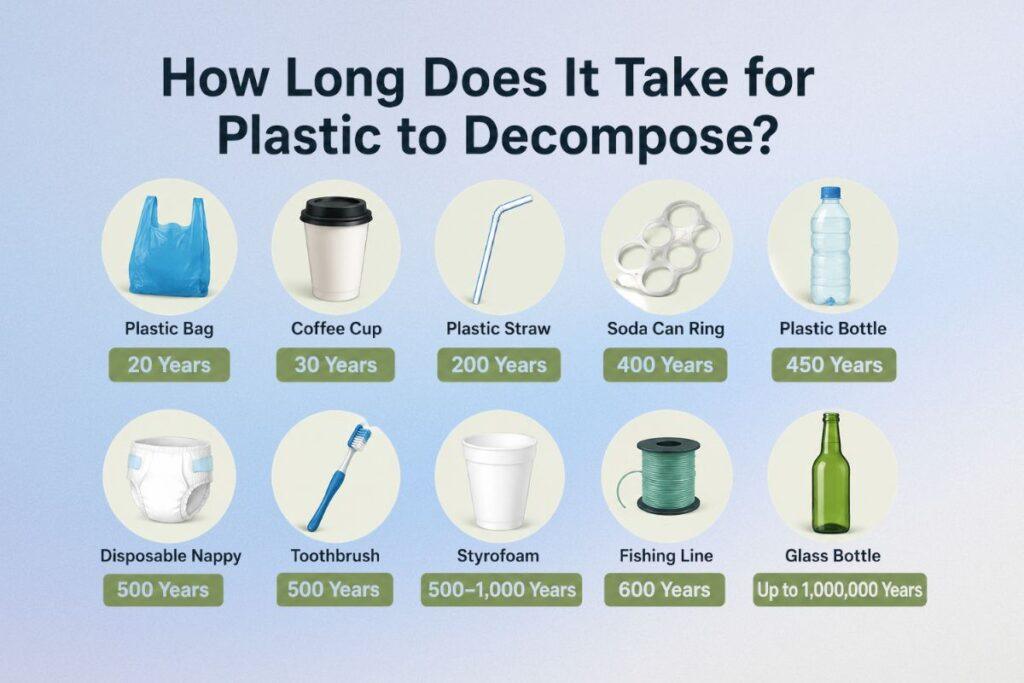
Every toothbrush you’ve ever owned is still out there somewhere. Every straw, every bottle, every little carrier bag from a supermarket trip. How long does it take for plastic to decompose? Longer than you’ve been alive, longer than your parents have been alive, and — depending on the plastic — longer than most countries have existed.
We’re talking 20 years on the low end. Up to a million for glass. Your average plastic bottle? A casual 450 years. Shakespeare-era vintage, had Shakespeare used PET. He didn’t. But yours does exist, and it’s going nowhere.
- Plastic takes 20 to 500+ years to break down, depending on the type.
- Bacteria won’t touch it. It simply doesn’t biodegrade.
- Sunlight (photodegradation) is the only thing that breaks it down, and even that just makes tinier plastic.
- 8 million metric tonnes of plastic enter the ocean every single year.
- Microplastics have turned up in the deepest ocean trench, in fish, and in human blood.
- “Biodegradable” plastic is largely a marketing stretch.
Bacteria Took One Look and Said No
When you bury an apple core, bacteria go wild for it, eat it, break it down, and return it to the soil. Bury a plastic bag? They stare at it blankly. Nothing to eat, nothing to do.
Ethique explains this with a respirometry test: shove plastic into ideal composting conditions and measure the bacteria’s CO₂ output. Organic matter produces loads. Plastic: absolute zero. The bacteria are completely ignoring it.
That’s because plastic is made from petroleum. Crude oil is chemically processed into something nature has never encountered and has no tools to digest. The only thing that actually degrades it is photodegradation. UV rays are slowly smashing polymer bonds apart, turning plastic brittle and crumbly. Dark twist: it doesn’t disappear. It becomes microplastics.
How Long Does Plastic Actually Last?
Chariot Energy compiled the timeline for common plastic items. None of it is cheerful reading.
| Material | Estimated Decomposition Time |
| Plastic bags | 20 years |
| Plastic-lined coffee cups | 30 years |
| Plastic straws | 200 years |
| Soda can rings | 400 years |
| Plastic bottles (PET) | 450 years |
| Disposable nappies | 500 years |
| Toothbrushes | 500 years |
| Styrofoam | 500–1,000 years |
| Fishing line | 600 years |
| Glass | Up to 1,000,000 years |
Fishing line at 600 years is especially grim; it spends most of that time drifting around, strangling marine life. The NOAA and Woods Hole Sea Grant confirmed these figures through marine-specific research, giving fishing line the dubious crown as the worst ocean offender.
Note: These figures are commonly cited estimates based on research from NOAA and Woods Hole Sea Grant. Actual decomposition times can vary significantly depending on environmental conditions such as sunlight exposure, temperature, and whether the item is in a landfill, ocean, or open environment.
Landfills Are Basically a Preservation Facility
You’d assume a landfill at least contains the problem. And it does — sort of. But most sites are compacted, sealed, and buried. No sunlight gets in, so photodegradation doesn’t happen. That bottle you binned in 2012 isn’t slowly breaking down somewhere. It’s sitting in the dark, perfectly preserved, biding its time.
The WWF notes that Australia produces nearly 3 million tonnes of plastic annually and recycles less than 19%. Up to 145,000 tonnes end up in the natural environment each year in rivers, beaches, and oceans. About 8 kilograms per person, potentially heading to sea.
The Ocean: Different Disaster, Same Outcome
Plastic in the ocean does get sunlight, which speeds things up. A 2009 study from Nihon University, presented at the American Chemical Society, found that plastic in warm seawater can begin breaking down within a year — though this process releases toxic chemicals like bisphenol A (BPA) directly into the water.
Sounds promising — except it’s not. Those chemicals end up in fish, which bigger fish eat, and which humans eat. Full circle, not in a good way.
The World Economic Forum reports 8 million metric tonnes of plastic entering the ocean annually. On current trends, there will be more plastic in the ocean than fish by weight by 2050. That sentence deserves its moment of silence.
The Microplastic Problem Nobody Wants to Sit With
As plastic fragments in landfills, rivers, and the sea, they don’t vanish. It becomes microplastics: fragments invisible to the naked eye that have turned up in the Mariana Trench, Arctic ice, plankton, whale stomachs, and human blood.
The long-term health effects on humans are still being studied. Nobody researching it closely seems particularly calm about what they’re finding.
On the upside, How Stuff Works covers Daniel Burd, a student who in 2008 proved bacteria could digest plastic and walked away with $10,000 at the Canada-Wide Science Fair. Other plastic-eating bacteria have since been found at dumpsites. Large-scale application doesn’t exist yet, but it’s the most exciting lead going.
As for biodegradable plastics: PLA (made from corn or sugarcane) can decompose in 47 to 90 days, but only inside commercial composting facilities at high heat. In a landfill or the ocean, it behaves just like regular plastic.
And because there’s no legal definition of “compostable plastic”, companies can print the label on packaging without meaningful evidence.
The Part Where We Be Honest
Your toothbrush will outlive your grandchildren. The straw from last Tuesday’s takeaway will still exist in the 23rd century. The most useful thing any of us can do right now is genuinely use fewer reusable bags, bottles, and cups. Not because it looks any better. Because nothing else is actually working at the pace we need.
FAQs
Q. How long does it take for a plastic bottle to decompose?
A. Standard PET plastic bottles take around 450 years to decompose. In a sealed landfill without sunlight, it takes even longer. Photodegradation requires UV light, which most buried landfill sites block entirely.
Q. Does plastic ever fully biodegrade?
A. No. Bacteria cannot break it down. Plastic only ever fragments into microplastic particles that persist indefinitely in soil, oceans, and (it turns out) the human body.
Q. How long does a plastic bag take to decompose?
A. Around 20 years with consistent sunlight exposure. In a sealed, compacted landfill, considerably longer, essentially put on indefinite pause.
Q. What is photodegradation?
A. It’s the process where UV light breaks apart the molecular bonds in plastic, making it brittle and crumbly. Plastic’s only natural degradation route, but the end product is toxic microplastics, not anything harmless.
Q. Are biodegradable plastics actually better?
A. Only in specific industrial conditions. PLA-based plastics decompose in 47 to 90 days in commercial composting facilities at high heat. Anywhere else – landfill, ocean, or regular bin – they behave almost identically to conventional plastic.
Q. What are microplastics, and is it worth being concerned?
A. Microplastics are the invisible fragments left as plastic breaks apart. They are found in ocean trenches, in wildlife, and in human blood. Research into long-term health effects is ongoing — and the scientists doing that research are not looking relaxed.
Sources & References:
- Chariot Energy – The decomposition time of different plastics varies.
- WWF – Australia produces nearly 3 million tonnes of plastic annually and recycles less than 19%.
- World Economic Forum – Every year 8 million metric tonnes of plastic enter the ocean.
- How Stuff Works – Daniel Burd, a student who in 2008 proved bacteria could digest plastic.