
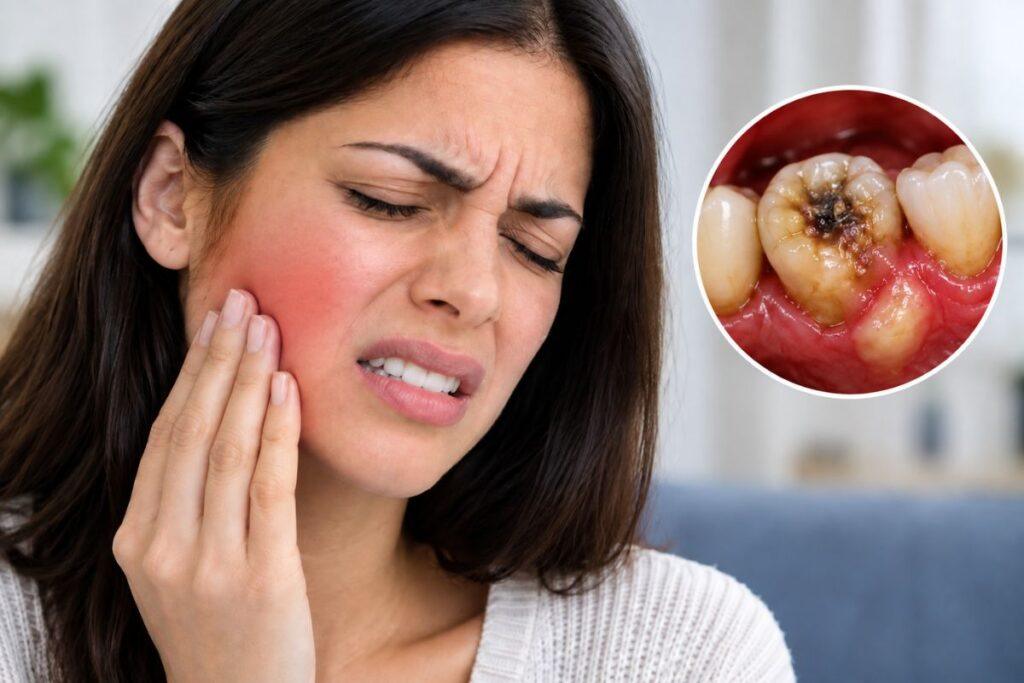
There’s no fixed timeline that tells you how long until a tooth infection kills you. Most end in a filling. A few end up in hospital. If ignored, an abscess can spread into your jaw, neck, airway or blood over days, weeks, or even months, and that’s when it becomes severe.
- They don’t heal. Not with rinses, not with time.
- An abscess can take months to form, then spread within days.
- Face swelling, fever, and a jaw that will not open mean it is spreading.
- If you can’t breathe or swallow, call 999.
What is a Tooth Infection?
A tooth infection is caused by bacteria inside the pulp of the tooth, surrounded by nerves and blood vessels. It creates a hole in the outside. It can happen in a cavity, a chip, a crack, a knock from playing football, or an old filling gone bad. Your body fights it, and pus comes out. A pus trapped in a pocket is an abscess.
Cleveland Clinic classifies tooth infections into three types. Gingival: It attacks the gum only. Periapical: forms at the root tip. Periodontal: starts in the bone and gum that hold your tooth in place, usually after gum disease.
How Long Until a Tooth Infection Kills You?
Decay is slow. Healthline states an abscess from plain decay takes several months to appear. Decay has to tunnel all the way to the pulp. Crack a tooth, and you’ve handed bacteria a front door.
Then the pain arrives. Throbbing, on and off, becomes worse when you bite, and the infected area swells. Casae reports of people who got seriously ill or died share a pattern: toothache dragging on for weeks or months without treatment.
If you leave it as it is, it climbs to the jaw, neck, or brain. Swallowing goes, breathing goes, and your mouth won’t open. At this point, if care isn’t received, death can occur quickly, sometimes in a matter of days.
Want a number? There isn’t one. Manhattan Medical Arts states, ‘A tooth infection will kill you in two weeks” and “you can safely wait a month”. In London during the 1600s, dental infections were listed as the fifth or sixth leading cause of death. Even as late as 1908, dental infections still caused death in 10 to 40 percent of cases. Then came antibiotics and proper dentistry. Dying of a bad tooth now is very rare.
Tooth Infection Stages
| What you’ve got | What’s going on | What you do |
| Twinges, sore to bite | Decay, inflamed pulp | Book the dentist |
| Puffy gum, pus, foul taste | Abscess, probably | Urgent appointment |
| Face swelling, fever, locked jaw | It’s spreading | Same-day assessment |
| Neck swelling, dribbling, muffled voice | Airway at risk | Go to A&E |
| Can’t breathe, confused | Sepsis or airway closing | Dial 999 |
Warning Signs and Risks You Should Never Ignore
Ring the dentist for throbbing that won’t quit, red puffy gums, a foul taste on repeat, breath that’d clear a room, a greying tooth, wincing at hot, cold or pressure, a wobbly tooth, a weeping sore on the gum, jaw swelling, or tender lumps under the chin.
You should be at the hospital when you have a fever of 38°C or more, feel wiped out, have a headache, have queasiness, feel sick, or have swelling across your face or neck or towards an eye; have a locked jaw; have trouble speaking or chewing; have dribbling because swallowing hurts; have a muffled voice; have a heart galloping; have trouble breathing; and have confusion.
Also read: How Long Does a Migraine Last? Duration, Stages & Relief Tips
The Complications That Can Kill
Sepsis is when your immune system attacks your body. Ludwig’s angina floods the floor of the mouth and shoves the tongue up until the airway is a straw. StatPearls pins it mostly on lower molars, and medics guard the airway.
The rest reads like a horror index. Necrotising fasciitis in soft tissue. Mediastinitis between the lungs. Endocarditis on the heart lining. Cavernous sinus thrombosis behind the eyes. Osteomyelitis in bone. Abscess and meningitis in the brain. Upper teeth sit so close to the sinus that infection tunnels in.
Who Faces the Greatest Risk
PVPD points at four: the elderly, anyone immunocompromised, diabetics, and people worn down by long illness. Slower immune response, longer fight. Smoke? You are twice as likely to get an abscess. Dry mouth is a bacteria playground: sugar and sloppy brushing are an invitation.
When the Pain Stops, Do Not Relax
The pain vanishes; you reckon you’ve dodged it. You haven’t. The pulp has died. The Merck Manual says that when the nerve is dead, there is no signal and no pain, but later it can roar back as an abscess around the root.
What If the Abscess Bursts?
A sudden salty, foul-tasting gush and blissful relief. Mayo Clinic says don’t be fooled: pressure’s out, infection isn’t. Don’t go squeezing one yourself.
Why Antibiotics Alone Will Not Fix It
The American Dental Association advises dentists against reflex antibiotics for most localised infections in healthy adults. Pills chase bacteria. They can’t scoop out dead pulp or plug a hole. Root canal or extraction every time.
They earn their place when you’re feverish, and it’s spreading — tablets, or into a vein if it gets bad.
Also read: What is Pneumonic Plague? What Happens in the First 72 Hours and How Dangerous Is It?
Treatment and What To Do Tonight
Three ways out. A nick in the gum to drain it, sometimes with a little rubber drain left in. A root canal: cleaned, filled, crowned, and looked after. It’ll see you out. Or the tooth comes out.
In the UK, phone your practice first. The NHS says to ring 111 if nobody can see you urgently — A&E — or 999 if your breathing or swallowing worsens.
Tonight: ibuprofen or paracetamol if they suit you. Warm salt water or hydrogen peroxide swills. Cold compress on the cheek. Soft food, chewed on the good side. Nothing scalding, freezing, acidic, spicy or crunchy. Soft brush and floss away from that tooth. Garlic is genuinely antimicrobial if you fancy it. None of it cures; it gets you to the chair.
How To Prevent a Tooth Infection
Use fluoride paste twice a day for two minutes each time. Floss or use a water flosser daily. New brush every three or four months. Ease off the sugar. Keep your check-ups. And when something chips, cracks or twinges, go then. Not in six months.
FAQs
Q. Can a tooth infection kill you overnight?
A. Rarely. But swelling that shuts your airway can become critical in hours.
Q. How do I know it’s got into my blood?
A. You may have a high fever, chills, a racing pulse, rapid breathing, dizziness, or confusion. This is the sepsis state, so go to hospital as soon as possible.
Q. How long can you live with an abscessed tooth?
A. You can live with an abscessed tooth for months, and sometimes you barely notice it. The risk stacks the whole time and can blow up without warning.
Q. Can a tooth infection go away on its own?
A. No. Pain fades; bacteria don’t. Only treatment eliminates the bacteria.
Q. Can it come back after a root canal?
A. Occasionally. Bacteria survive, or a filling leaks years later. Fresh pain or swelling needs checking.
Q. Can mouthwash cure an abscess?
A. Not a chance. It freshens your breath. It can’t drain pus or clean dead pulp.
Sources & References:
- Healthline – An abscess from plain decay takes several months to appear.
- Cleveland Clinic – Tooth infection is classified into three types.
- PVPD – The elderly, anyone immunocompromised, diabetics, and people worn down by long illness are most at risk
- Manhattan Medical Arts – A tooth infection will kill you in two weeks” and “you can safely wait a month”.